Top AI Business Ideas for Startups in (2026)
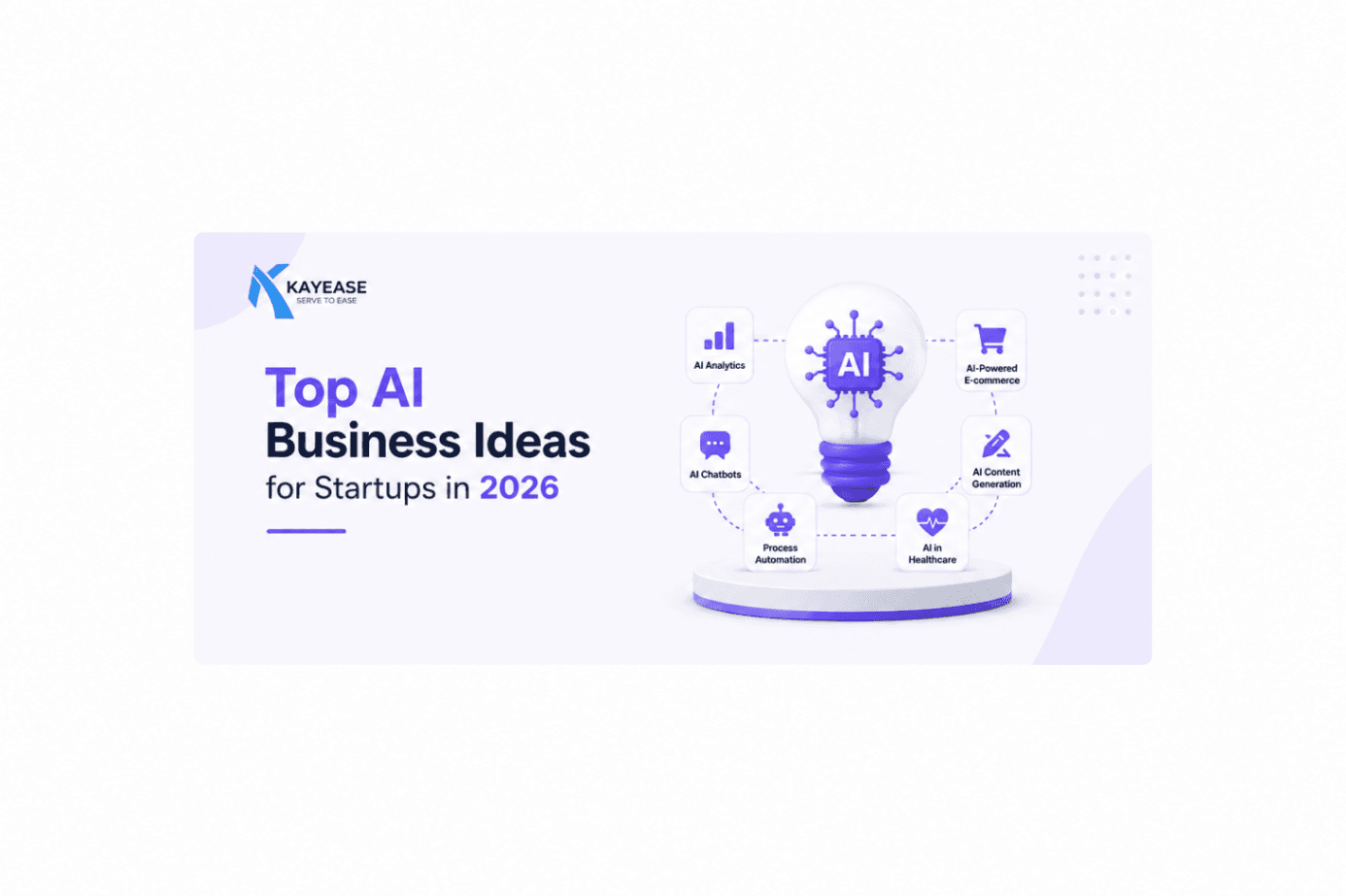
Discover the top AI business ideas for startups in 2026. Explore profitable opportunities in AI automation, customer support, healthcare, recruitment, cybersecurity, and more.
Top AI Business Ideas for Startups in 2026
Abstract
Artificial Intelligence is no longer limited to large enterprises with massive budgets. In 2026, startups have unprecedented opportunities to build scalable, profitable, and innovative businesses powered by AI. From intelligent automation and personalized customer experiences to AI driven healthcare and content creation, entrepreneurs are leveraging AI to solve real world problems faster than ever before. This article explores the most promising AI business ideas for startups in 2026, why they matter, and how founders can identify opportunities that align with emerging market demands.
Top AI Business Ideas for Startups in 2026
Introduction
Imagine waking up to find that your AI assistant has already answered customer queries, generated sales reports, scheduled meetings, and identified new business opportunities while you were asleep.
Just a few years ago, this sounded like science fiction. Today, it is becoming a reality.
The AI revolution is creating opportunities similar to the early days of the internet and mobile apps. Businesses across industries are searching for smarter ways to automate tasks, reduce costs, improve customer experiences, and make better decisions. While large corporations are investing billions in AI, startups have a unique advantage: speed, innovation, and the ability to solve niche problems.
The biggest opportunities in 2026 won't necessarily come from building the next ChatGPT. Instead, they will come from applying AI to solve specific business challenges that people encounter every day.
So where should entrepreneurs focus their attention?
Let's explore the top AI business ideas that have the potential to shape the startup landscape in 2026.
Why AI Startups Are Booming in 2026
Several factors are driving the rapid growth of AI businesses:
- AI tools are more accessible than ever.
- Development costs have decreased significantly.
- Businesses actively seek automation solutions.
- AI adoption is becoming mainstream across industries.
- Customers expect faster and more personalized experiences.
According to industry reports, global AI spending continues to rise as organizations prioritize efficiency, productivity, and data-driven decision-making.
For startups, this creates a perfect environment to launch AI-powered products and services.
1. AI Automation Agency
The Problem
Many businesses still waste hours on repetitive tasks such as data entry, lead management, invoice processing, and customer support.
The Opportunity
An AI automation agency helps companies automate workflows using AI tools, chatbots, integrations, and custom automation systems.
Real-Life Example
A small logistics company spends four hours daily manually updating shipment records. An AI-powered automation system can reduce that work to a few minutes, saving hundreds of hours every year.
Revenue Model
- Setup fees
- Monthly retainers
- Custom AI integration projects
2. AI Customer Support Solutions
The Problem
Businesses struggle to provide 24/7 customer service while controlling costs.
The Opportunity
Develop AI chatbots and virtual assistants that answer questions, process requests, and escalate complex issues to human agents.
Real-Life Example
An online store receives hundreds of repetitive inquiries about order status and returns. AI can handle most of these interactions instantly.
Revenue Model
- SaaS subscriptions
- Per-conversation pricing
- Enterprise licensing
3. Industry-Specific AI Assistants
The Problem
Generic AI tools often lack industry knowledge.
The Opportunity
Create specialized AI assistants for sectors such as:
- Healthcare
- Legal services
- Real estate
- Education
- Manufacturing
Real-Life Example
A real estate AI assistant can instantly analyze property listings, generate marketing descriptions, and answer buyer questions.
Revenue Model
- Monthly subscriptions
- Usage-based pricing
- White-label solutions
4. AI Content Creation Platform
The Problem
Businesses constantly need content for websites, social media, emails, and advertising.
The Opportunity
Develop AI tools that generate high-quality content tailored to specific industries or marketing goals.
Real-Life Example
A local restaurant owner needs daily social media content but lacks a marketing team. AI can generate engaging posts in seconds.
Revenue Model
- Subscription plans
- Credit-based systems
- Premium content packages
5. AI-Powered Recruitment Platform
The Problem
Hiring the right talent is expensive and time-consuming.
The Opportunity
Build AI systems that screen resumes, rank candidates, schedule interviews, and assess skills.
Real-Life Example
A startup receives 1,000 applications for a single position. AI can identify top candidates within minutes.
Revenue Model
- Per-hire fees
- HR software subscriptions
- Enterprise contracts
6. AI Healthcare Solutions
The Problem
Healthcare providers face increasing administrative workloads and patient demands.
The Opportunity
Develop AI tools for:
- Appointment scheduling
- Medical documentation
- Patient engagement
- Diagnostic assistance
Real-Life Example
Doctors spend significant time writing clinical notes. AI can automatically generate documentation from conversations.
Revenue Model
- Healthcare SaaS
- Licensing agreements
- Custom implementation projects
7. AI Cybersecurity Services
The Problem
Cyber threats are becoming more sophisticated.
The Opportunity
Create AI-powered security solutions that monitor systems, detect anomalies, and respond to threats in real time.
Real-Life Example
An AI system identifies unusual login behavior and prevents a data breach before it occurs.
Revenue Model
- Subscription services
- Managed security solutions
- Enterprise licensing
8. AI Personal Finance Assistant
The Problem
Many people struggle with budgeting, saving, and financial planning.
The Opportunity
Build AI tools that provide personalized financial guidance and spending insights.
Real-Life Example
An AI assistant notices excessive spending patterns and recommends budget adjustments automatically.
Revenue Model
- Premium subscriptions
- Financial partnerships
- Advisory services
9. AI Education and Learning Platforms
The Problem
Traditional education often lacks personalization.
The Opportunity
Create AI-powered learning systems that adapt to individual student needs.
Real-Life Example
A student struggling with mathematics receives customized lessons and practice exercises generated by AI.
Revenue Model
- Course subscriptions
- School partnerships
- Corporate training programs
10. AI Market Research and Business Intelligence
The Problem
Companies collect massive amounts of data but struggle to extract actionable insights.
The Opportunity
Develop AI platforms that analyze market trends, customer behavior, and competitive landscapes.
Real-Life Example
A startup launching a new product uses AI to identify emerging customer preferences before competitors do.
Revenue Model
- Monthly subscriptions
- Data analytics services
- Enterprise solutions
How to Choose the Right AI Startup Idea
Before building an AI business, ask yourself:
1. Is It Solving a Real Problem?
Successful startups solve painful, expensive, or time-consuming problems.
2. Is There a Paying Market?
Validation should come before development.
3. Can AI Create a Significant Advantage?
Avoid adding AI simply because it's trendy.
4. Can the Business Scale?
Look for opportunities that can grow without proportional increases in costs.
5. Do You Have Industry Knowledge?
The most successful AI startups often combine technical expertise with deep industry understanding.
The Biggest Opportunity Most Entrepreneurs Miss
Many founders focus on creating groundbreaking AI models. However, the real opportunity often lies elsewhere.
Businesses don't necessarily need better AI.
They need AI that understands their specific challenges.
A law firm wants legal expertise. A hospital wants healthcare expertise. A logistics company wants supply chain expertise.
The winners of 2026 will be startups that combine AI capabilities with deep industry specialization.
Conclusion
The AI startup landscape in 2026 offers enormous potential for entrepreneurs willing to solve practical business problems. Whether it's automation, customer support, healthcare, cybersecurity, education, or industry-specific AI assistants, the most successful ventures will focus on delivering measurable value rather than simply adopting AI for its own sake.
As AI technology becomes more accessible, the barrier to entry continues to decrease. This means the greatest competitive advantage will no longer be access to AI itself but the ability to apply it effectively to real-world challenges.
For startups looking to build the next generation of innovative businesses, there has never been a better time to turn AI-driven ideas into reality.
References
- NASSCOM : AI Adoption and Digital Transformation Reports
- Ministry of Electronics & Information Technology (MeitY)
- Invest India : AI Industry Insights
- PwC India : AI Economic Impact Reports
- McKinsey & Company : State of AI Reports
- Gartner : Technology Trend Reports
- Statista : AI Market Statistics
- IDC : AI Spending Guide
- World Economic Forum : Future of Jobs Report
- OpenAI : AI Business Resources
Never miss a post
Subscribe to our RSS feed and every new article lands in your reader automatically — no email, no algorithm.
Works with Feedly, Inoreader, NetNewsWire and any other reader. View raw feed