
SaaS Product Development: From Idea to Launch
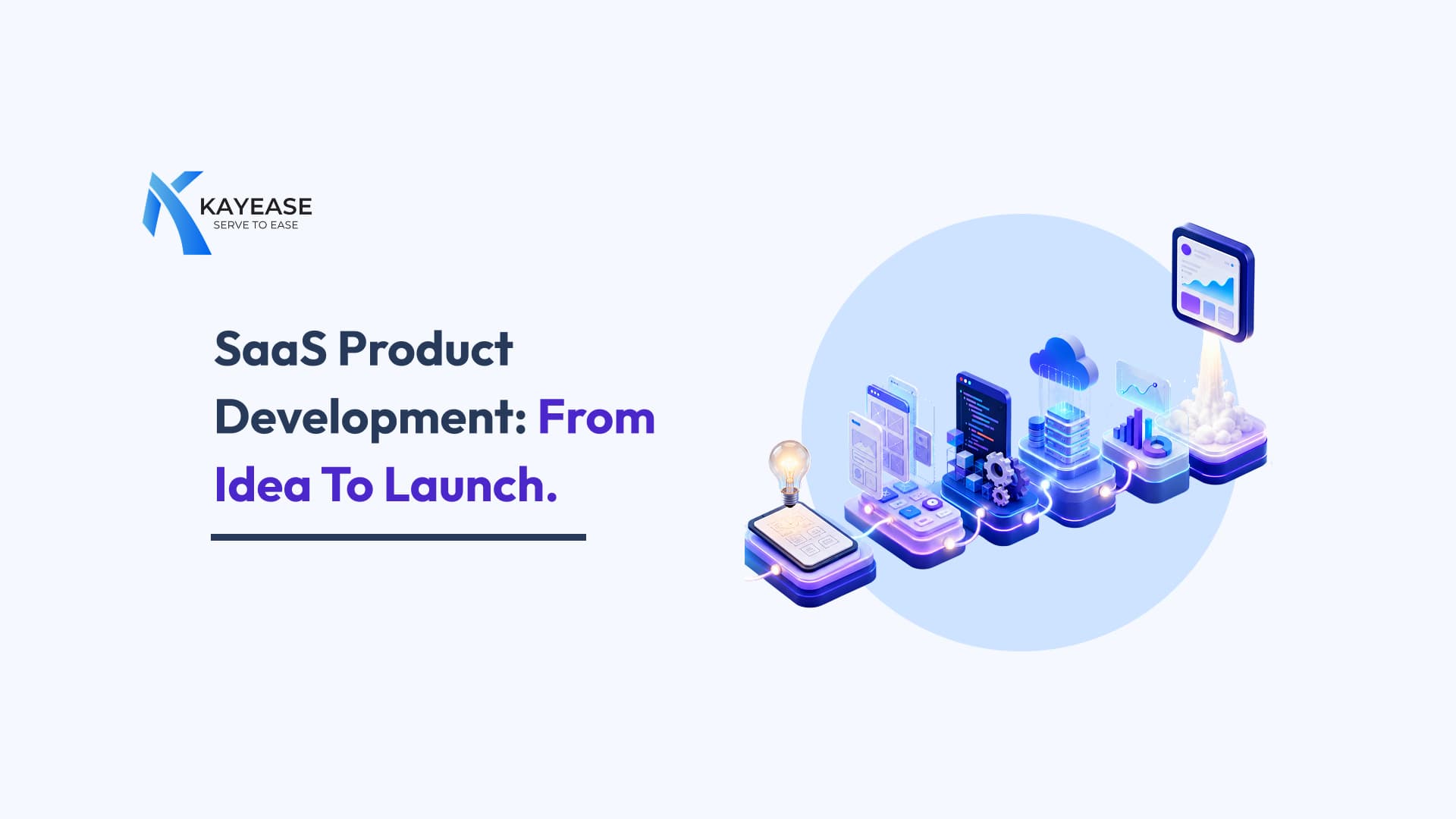
Learn how SaaS product development works from idea validation and MVP planning to design, development, testing, deployment, and launch.
SaaS Product Development: From Idea to Launch
Every SaaS product starts with an idea.
Maybe you’ve identified a problem that businesses struggle with every day. Maybe you have an idea for a platform that could automate a repetitive process. Or perhaps you’ve noticed a gap in an existing market and believe there’s a better way to solve it.
But an idea is only the beginning.
Turning that idea into a successful SaaS product requires much more than writing code. It involves market research, product strategy, UX design, technology, testing, deployment, and continuous improvement.
So, what does the journey from idea to launch actually look like?
Let’s break it down.
1. Start With the Problem, Not the Product
One of the biggest mistakes SaaS founders make is starting with the question:
“What should we build?”
A better question is:
“What problem are we solving?”
A strong SaaS product should solve a specific, meaningful problem for a clearly defined audience.
For example, instead of saying :
“We want to build a CRM.”
You might identify a more specific problem:
“Small sales teams are losing leads because follow-ups are being managed manually across WhatsApp, spreadsheets, and calls.”
Now you have a problem worth solving.
Before development begins, understand:
- Who experiences the problem?
- How frequently does it occur?
- How are they solving it today?
- What makes the existing solutions frustrating?
- Would they pay for a better solution?
The clearer the problem, the stronger the product foundation.
2. Validate the SaaS Idea
Not every good idea is necessarily a good SaaS business.
Before investing significant resources into development, validate your concept.
Talk to potential customers. Study competitors. Analyze market demand. Identify existing alternatives and understand what they are missing.
Your goal isn't to prove that your idea is perfect.
Your goal is to discover whether there is a real problem, a real audience, and a real willingness to pay for the solution.
Validation can include:
- Customer interviews
- Competitor analysis
- Surveys
- Landing pages
- Prototype testing
- Market research
- Early-access or waitlist campaigns
This stage can save months of development later.
3. Define the MVP
Once the idea is validated, it's time to decide what you're actually going to build.
This is where the Minimum Viable Product (MVP) comes in.
An MVP isn't a poorly built version of your final product.
It's the smallest useful version of your product that solves the core customer problem.
For example, a sales automation SaaS might initially require:
- User authentication
- Lead management
- Sales pipeline
- Follow-up reminders
- Basic reporting
Advanced AI features, complex integrations, custom dashboards, and dozens of automation rules can come later.
The objective is simple:
Build what customers need first.
4. Create the Product Architecture
Once the product scope is defined, the technical foundation needs to be planned.
A SaaS architecture typically considers:
- Frontend technology
- Backend architecture
- Database structure
- APIs
- Authentication and authorization
- Cloud infrastructure
- Data security
- Scalability
- Third-party integrations
- Monitoring and logging
For SaaS products serving multiple organizations, multi-tenancy is another important architectural consideration.
A well-designed architecture allows the platform to scale without requiring a complete rebuild whenever your customer base grows.
5. Design the User Experience
A powerful product can still fail if users don't understand how to use it.
UX design should make the product intuitive from the first interaction.
The design process may include:
User flows → Wireframes → Prototypes → UI design → Usability testing
Think about the user's journey.
What happens when they sign up?
How quickly can they reach the main value of the product?
Can they understand the dashboard without training?
Can they complete important tasks with minimal friction?
For SaaS products, usability directly affects activation, retention, and customer satisfaction.
6. Develop the Product
Now the idea starts becoming a working product.
Development typically happens in iterations or sprints.
Frontend developers build the user interface.
Backend developers implement business logic, APIs, authentication, integrations, and data management.
Developers may also implement:
- Role-based access control
- Notifications
- Payment systems
- Subscription management
- Analytics
- Automated workflows
- Third-party integrations
The development process should remain closely connected to the original product requirements.
Building more features doesn't automatically create more value.
7. Test Before You Launch
A SaaS product shouldn't go directly from development to customers.
Testing is essential.
Quality assurance teams test the product from multiple perspectives, including:
Functional Testing
Does each feature work as expected?
Usability Testing
Can users understand and navigate the product easily?
Performance Testing
Can the platform handle expected traffic and workloads?
Security Testing
Are authentication, authorization, data access, and sensitive information properly protected?
Compatibility Testing
Does the application work across supported browsers, devices, and environments?
Testing isn't simply about finding bugs.
It's about making sure customers can rely on the product.
8. Set Up Deployment and Infrastructure
A SaaS product needs reliable infrastructure before it goes live.
This can include:
- Cloud hosting
- Production databases
- SSL certificates
- Domain configuration
- CI/CD pipelines
- Backup systems
- Monitoring
- Error tracking
- Logging
- Security controls
Automation through CI/CD can make future releases faster and safer by allowing teams to build, test, and deploy changes systematically.
9. Prepare for the Launch
Launching a SaaS product isn't just a technical event.
It's a business event.
Before launch, make sure you have:
- A clear value proposition
- Website or landing page
- Pricing strategy
- Product documentation
- Onboarding flow
- Support process
- Analytics
- Customer communication
- Marketing plan
Your potential customer should quickly understand three things:
What is the product?
What problem does it solve?
Why should I choose it?
If those answers aren't clear, even a technically excellent product can struggle to gain traction.
10. Launch, Learn, and Improve
The first launch isn't the finish line.
It's the beginning of the next stage.
Once users start interacting with your SaaS product, you'll collect valuable information about what works and what doesn't.
Track metrics such as:
- Sign-ups
- Activation rate
- Customer acquisition cost
- Monthly recurring revenue (MRR)
- Churn rate
- Customer lifetime value (CLV)
- Feature adoption
- Retention
More importantly, listen to your customers.
Sometimes the feature customers request most isn't the feature you expected them to need.
That's why successful SaaS products evolve continuously.
Common SaaS Development Mistakes
Building Too Many Features
Trying to launch with every possible feature can increase development time and complexity.
Start with the core value proposition.
Ignoring Security
SaaS platforms often handle sensitive business and customer data. Security should be considered from the architecture stage not added as an afterthought.
Focusing Only on Development
A technically excellent product doesn't guarantee product-market fit.
Product strategy, UX, marketing, sales, and customer support matter just as much.
Skipping User Feedback
Your assumptions aren't a substitute for customer feedback.
Build, release, measure, learn, and iterate.
How Long Does SaaS Product Development Take?
There is no universal timeline.
A simple MVP may take a few months, while a complex enterprise SaaS platform can require significantly longer.
The timeline depends on factors such as:
- Product complexity
- Number of features
- Integrations
- Design requirements
- Technology stack
- Team size
- Security requirements
- Testing scope
- Regulatory requirements
The right goal isn't simply to launch quickly.
It's to launch a useful, reliable product that can evolve.
From Idea to SaaS Product
The SaaS journey can be summarized as:
Idea → Problem Validation → MVP → Architecture → UX/UI → Development → Testing → Deployment → Launch → Optimization
Every stage matters.
A great SaaS product isn't created by technology alone. It comes from combining a genuine customer problem, thoughtful product strategy, strong engineering, intuitive design, and continuous learning.
At Kayease, we approach SaaS development as a complete product journey not simply a software development project.
From transforming an idea into a product strategy to designing, developing, testing, deploying, and scaling the platform, the focus remains the same:
Build technology that solves real business problems.
Because the goal isn't just to launch software.
It's to build a product people want to keep using.
Never miss a post
Subscribe to our RSS feed and every new article lands in your reader automatically — no email, no algorithm.
Works with Feedly, Inoreader, NetNewsWire and any other reader. View raw feed