How AI Automation Can Reduce Business Costs in 2026
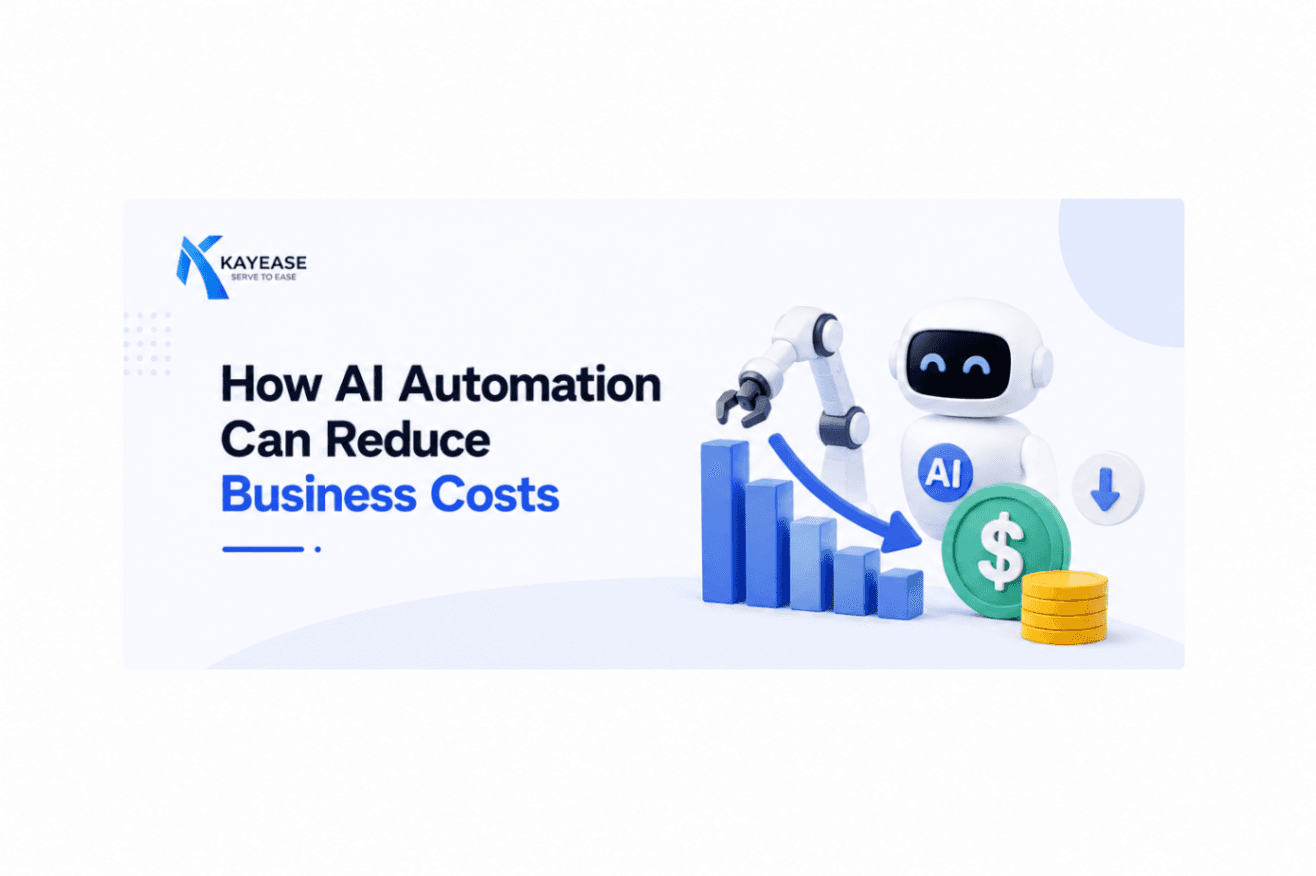
Hidden business costs often come from repetitive tasks, delays, and manual errors. Discover how AI automation helps Indian businesses reduce expenses, improve productivity, and scale efficiently in 2026.
How AI Automation Can Reduce Business Costs in India: The Hidden Expenses You Don't Realize You're Paying
Your employees spend hours updating spreadsheets, responding to the same customer questions, manually processing invoices, following up with leads, and generating reports. At the end of the month, everything gets done but at what cost?
Most businesses focus on visible expenses like salaries, rent, software subscriptions, and marketing budgets. However, the biggest cost drains are often hidden inside everyday operations.
A missed follow-up. A delayed invoice. A customer waiting for support. An employee spending three hours on a task that could be completed in three minutes.
These hidden inefficiencies quietly eat into profits every single day.
This is exactly why AI automation is becoming one of the fastest-growing business investments in India. Companies are discovering that reducing costs isn't always about spending less; sometimes it's about working smarter. The trend is supported by initiatives such as the India AI Mission, which aims to accelerate AI adoption and innovation across Indian industries.
Source: https://indiaai.gov.in
But how much money can AI actually save? And where are businesses losing money without even realizing it?
Let's find out.
The Cost Problem Most Businesses Never Measure
Ask a business owner where their money goes, and they'll usually mention payroll, operations, inventory, or marketing.
Ask them how much money is lost due to repetitive work, manual errors, delayed responses, or inefficient processes, and most won't have an answer.
That's because these costs don't appear as a separate line item in financial reports.
Consider this:
- A customer inquiry waits six hours for a response.
- A sales lead is forgotten.
- An invoice contains incorrect information.
- A report takes an entire day to prepare manually.
- An employee repeatedly performs the same administrative task.
Individually, these seem minor.
Collectively, they can cost businesses lakhs of rupees every year.
This is where AI automation changes the game.
What Happens When a Business Never Sleeps?
Imagine having a team member who works 24/7.
No breaks.
No holidays.
No sick leave.
No delays.
That's essentially what AI automation offers for repetitive business processes.
AI-powered systems can:
- Respond to customer inquiries instantly
- Process data automatically
- Generate reports in seconds
- Track inventory continuously
- Manage workflows without manual intervention
Instead of waiting for someone to perform a task, the system handles it automatically.
The result?
Faster operations and lower costs.
The ₹10 Lakh Question: How Much Does Manual Work Really Cost?
Let's do a simple calculation.
Suppose five employees spend just two hours every day on repetitive administrative tasks.
That's:
- 10 hours per day
- 50 hours per week
- More than 2,500 hours per year
Now imagine a significant portion of those tasks could be automated.
How much additional work could your team accomplish?
How many more customers could they serve?
How many opportunities are currently being lost simply because employees are busy doing work that software can handle?
Research from McKinsey suggests that generative AI could significantly increase productivity across business functions, helping organizations reduce operational inefficiencies and unlock new value.
Source: https://www.mckinsey.com/capabilities/quantumblack/our-insights/the-economic-potential-of-generative-ai-the-next-productivity-frontier
These are the questions businesses are beginning to ask.
And AI automation is providing the answers.
Why Customer Support Is Often the Biggest Cost Leak
Here's a surprising fact.
Most customer inquiries are repetitive.
Questions like:
- Where is my order?
- What are your pricing plans?
- What are your business hours?
- How can I reset my password?
- Can I schedule a demo?
Yet many businesses pay employees to answer the same questions hundreds of times every month.
AI chatbots can handle these conversations instantly.
Customers receive immediate answers.
Support teams focus on complex issues.
Businesses reduce support costs while improving customer satisfaction. According to IBM, AI-powered chatbots can automate a large percentage of routine customer interactions, allowing support teams to focus on more complex issues.
Source: https://www.ibm.com/topics/chatbots
Everyone wins.
The Expensive Mistake Called Human Error
Nobody likes talking about mistakes.
But mistakes are expensive.
A misplaced decimal.
An incorrect invoice.
A duplicate order.
A missed customer request.
These small errors can create larger financial problems.
AI systems don't get tired after eight hours.
They don't lose focus before a deadline.
They process information consistently and accurately.
For businesses handling large volumes of data, even a small reduction in errors can lead to significant cost savings.
The Sales Secret Most Businesses Overlook
Many companies assume they need more leads.
In reality, they often need better lead management.
Think about what happens when a potential customer fills out a contact form.
How quickly does someone respond?
Five minutes?
Five hours?
The next day?
Research consistently shows that faster responses improve conversion rates.
AI-powered sales automation can:
- Identify high-intent prospects
- Trigger instant follow-ups
- Prioritize valuable leads
- Schedule reminders automatically
The result isn't just cost savings.
It's increased revenue from opportunities that would otherwise be missed.
What If Your Inventory Could Predict the Future?
One of the biggest challenges for Indian businesses is inventory management.
Too much stock?
Money gets locked up.
Too little stock?
Sales are lost.
AI-powered inventory systems analyze historical data, buying patterns, seasonal demand, and market trends to make more accurate forecasts.
Instead of guessing what customers might buy next month, businesses can make data-driven decisions.
Less wastage .
Industry research from Deloitte highlights how AI-powered forecasting can help organizations improve inventory accuracy and supply chain performance.
Source: https://www2.deloitte.com
Better planning.
Lower costs.
The Department Nobody Talks About: Administrative Work
Every organization has work that simply needs to get done.
Reports.
Approvals.
Attendance tracking.
Leave management.
Payroll processing.
The problem is that these tasks consume enormous amounts of time.
AI automation can handle many of these responsibilities automatically, allowing employees to focus on activities that generate value rather than paperwork.
The savings may not be immediately visible, but over time they become substantial.
Why Indian SMEs Are Adopting AI Faster Than Ever
For years, AI was considered a luxury reserved for large corporations. That's no longer true.
Today, affordable cloud-based solutions allow small and medium-sized businesses to access powerful automation tools without investing heavily in infrastructure.
A growing startup can automate customer support.
A manufacturer can automate inventory tracking.
A retailer can automate sales reporting.
A service company can automate lead management.
AI is becoming accessible to businesses of every size.
And those who adopt early often gain a competitive advantage.
The Real Question Isn't Whether You Need AI
It's whether your competitors are already using it. While one company manually processes invoices, another automates them. While one business responds to inquiries the next morning, another responds instantly. While one team spends hours generating reports, another receives real-time insights automatically. The difference grows over time. Small efficiencies become major advantages. Minor savings become significant profits. And businesses that embrace automation often find themselves operating faster, leaner, and more effectively than competitors.
The Future of Cost Reduction Has Already Started
Every business wants to reduce costs. But cutting expenses alone isn't a sustainable strategy. The companies growing fastest in 2026 aren't simply spending less. They're eliminating inefficiencies. They're automating repetitive work. They're using AI to help teams focus on what humans do best: solving problems, building relationships, and driving innovation.
NITI Aayog has identified artificial intelligence as a key technology for improving productivity and accelerating digital transformation across multiple sectors in India.
Source: https://www.niti.gov.in
AI automation isn't about replacing people.
It's about removing the work that slows people down.
And for businesses across India, that shift could be one of the most valuable investments they make.
Conclusion
The biggest business expenses aren't always the ones you can see.They're hidden in delays, repetitive tasks, missed opportunities, manual errors, and inefficient processes.AI automation helps uncover and eliminate these hidden costs, creating a smarter and more profitable way to operate.The question is no longer whether AI can reduce business costs.
The real question is: How much money is your business losing by not using it yet?
Never miss a post
Subscribe to our RSS feed and every new article lands in your reader automatically — no email, no algorithm.
Works with Feedly, Inoreader, NetNewsWire and any other reader. View raw feed