
Digital Transformation Through Custom Software in India
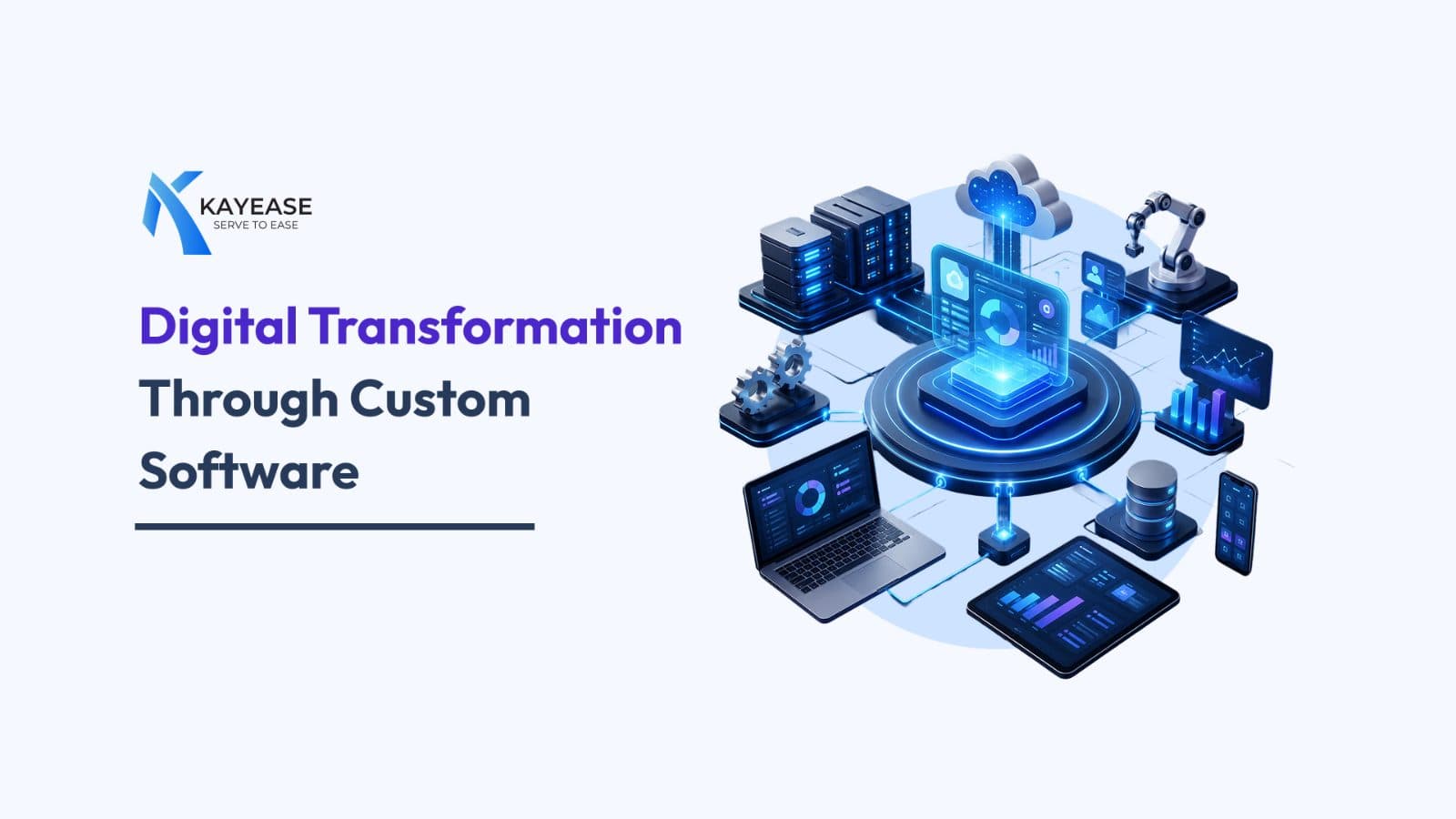
Digital transformation through custom software is helping Indian businesses automate processes, improve productivity, make data-driven decisions, and scale efficiently. Learn why customized software can be a smarter approach to modern business growth.
What Is Digital Transformation Through Custom Software?
Digital transformation through custom software means using technology specifically designed around a business's processes, goals, customers, and operational requirements.
Instead of adapting business operations to fit an off-the-shelf software product, custom software allows businesses to build technology around the way they actually work.
For Indian businesses, this can be particularly valuable because companies often operate across different locations, teams, customer segments, payment methods, regulatory requirements, and rapidly changing market conditions.
Custom software can help bring these processes together into a centralized digital ecosystem.
Why Is Digital Transformation Important for Indian Businesses?
India's business environment is becoming increasingly digital. From UPI payments and e-commerce to cloud platforms, AI-powered tools, digital customer service, and remote operations, technology is changing how businesses operate and compete.
However, simply purchasing new software does not automatically create digital transformation.
Businesses need technology that solves actual operational problems.
For example, a growing company may still manage leads through spreadsheets, communicate with customers through multiple platforms, manually generate reports, or use separate systems for different departments.
These disconnected processes can create delays, duplicate data, errors, and unnecessary administrative work.
A well-planned digital transformation strategy can connect these operations and create a more efficient workflow.
How Does Custom Software Help Businesses Transform?
Custom software can support digital transformation in several important ways.
1. Automates Repetitive Business Processes
Manual tasks consume valuable employee time and can increase the possibility of human error.
Custom software can automate repetitive activities such as:
- Data entry
- Lead management
- Customer follow-ups
- Report generation
- Invoice processing
- Employee workflows
- Notifications
- Document management
- Approval processes
Automation allows employees to spend more time on activities that require decision-making, creativity, and customer interaction.
2. Connects Different Business Operations
Many businesses use multiple applications for different departments.
Sales may use one platform, finance another, while operations rely on spreadsheets and manual communication.
This can create information silos.
Custom software can integrate different processes into a centralized system, allowing information to move more efficiently between departments.
For example:
Lead → Sales Team → Customer → Order → Payment → Reporting
Instead of managing each stage separately, businesses can create a connected digital workflow.
3. Provides Real-Time Business Data
Business decisions are stronger when they are based on accurate and timely information.
Custom dashboards can provide real-time visibility into important metrics such as:
- Sales performance
- Revenue
- Customer activity
- Employee productivity
- Inventory
- Operational performance
- Financial data
Management teams can use these insights to identify problems faster and make informed decisions.
Can Custom Software Help Indian SMEs Scale?
Yes. Custom software can help Indian SMEs scale by automating repetitive operations, centralizing data, improving workflow efficiency, and reducing dependency on manual processes.
This is especially useful for businesses that have outgrown spreadsheets or generic software but aren't ready to completely restructure their operations around a rigid platform.
A custom solution can evolve as the business grows.
For example, a company may initially need a simple CRM. As it expands, it may require sales automation, employee management, analytics, customer portals, integrations, and mobile access.
Custom software can be developed with this growth in mind.
4. Creates Software Around Your Business Workflow
One of the biggest advantages of custom software is flexibility.
Every business has its own processes.
A manufacturing company doesn't operate like a school. A financial services company doesn't operate like an e-commerce business.
Even two companies within the same industry can have completely different workflows.
Custom software can be designed around specific requirements instead of forcing employees to change their processes to accommodate generic software.
This can improve adoption and make technology more useful for employees.
5. Improves Customer Experience
Digital transformation isn't only about internal operations.
It can also improve how customers interact with a business.
Custom software can provide features such as:
- Customer portals
- Self-service dashboards
- Faster support
- Automated notifications
- Personalized communication
- Online payments
- Order tracking
- Real-time status updates
When customers can access information quickly and conveniently, their overall experience can improve.
For Indian businesses operating in competitive markets, customer experience can become an important differentiator.
6. Improves Data Security and Control
Businesses handle sensitive information every day, including customer details, financial information, employee data, business documents, and operational records.
With a custom software solution, organizations can design access controls and workflows around their specific security requirements.
Different users can receive different permissions based on their roles.
For example:
Admin → Manager → Employee → Customer
Each user can access only the information and functionality relevant to them.
Security requirements should be considered from the beginning of the software development process rather than added as an afterthought.
What Is the Difference Between Custom Software and Off-the-Shelf Software?
Off-the-shelf software is developed for a broad market and generally provides standardized features. Custom software is developed around the specific requirements of an organization. Custom Software Off-the-Shelf Software, Designed for specific business requirements, Designed for a broad user base, Highly customizable, Limited customization Can evolve with the business Dependent on vendor roadmap Can integrate with existing systems Integrations may be limited Greater control over workflows Standardized workflows Can be built for specific scalability requirements Scalability depends on the product Neither option is automatically better for every business. The right choice depends on the organization's budget, processes, growth plans, technical requirements, and long-term objectives.
7. Enables AI, Analytics, and Automation
Digital transformation is moving beyond basic digitization. Modern businesses are increasingly exploring:
- Artificial intelligence
- Machine learning
- Predictive analytics
- Intelligent automation
- Business intelligence
- Chatbots
- Recommendation systems
- Automated reporting
Custom software can provide a foundation for incorporating these technologies into business workflows. For example, AI could help identify sales patterns, predict customer behavior, automate support, or analyze large amounts of business data. The key is to use technology where it solves a genuine business problem rather than adding AI simply because it is trending.
How Should Indian Businesses Start Their Digital Transformation Journey?
Digital transformation doesn't have to happen all at once.
A practical approach is to start by identifying the biggest operational challenges.
Step 1: Identify Manual Processes
Find repetitive tasks that consume significant employee time.
Step 2: Identify Business Bottlenecks
Look for delays, communication gaps, duplicate data, and inefficient workflows.
Step 3: Define Business Requirements
Determine what the software needs to accomplish before deciding what technology to use.
Step 4: Prioritize Features
Start with the features that provide the highest business value instead of trying to build everything at once.
Step 5: Build an MVP
A minimum viable product can help businesses test the solution with real users before expanding it.
Step 6: Integrate Existing Systems
Connect important tools and platforms wherever possible instead of creating isolated software.
Step 7: Measure Results
Track improvements in productivity, cost, customer satisfaction, processing time, and revenue.
What Are the Challenges of Digital Transformation?
Digital transformation can provide significant benefits, but it also comes with challenges.
Common challenges include:
- Resistance to change
- Poorly defined requirements
- Lack of technical expertise
- Integration difficulties
- Data migration
- Cybersecurity risks
- Budget constraints
- Employee training
- Poor project planning
The solution isn't simply to invest more money in technology.
Businesses need a clear transformation strategy that connects technology investment with measurable business objectives.
Why Choose Custom Software Development in India?
India has a strong technology ecosystem with access to software developers, IT companies, engineering talent, and technology specialists.
For businesses looking for custom software development in India, working with the right development partner can provide access to technical expertise while allowing organizations to build solutions suited to their specific requirements.
The right partner should understand more than coding.
They should understand:
- Business processes
- User experience
- Scalability
- Cloud infrastructure
- Security
- Integrations
- Data
- Testing
- Long-term maintenance
A successful software project should solve a business problem not simply deliver an application.
How Much Does Custom Software Development Cost in India?
The cost of custom software development in India depends on several factors, including the project's complexity, number of features, integrations, platforms, UI/UX requirements, security requirements, development timeline, and ongoing maintenance.
A simple internal application will have very different development requirements from a large enterprise platform.
Instead of focusing only on the initial development cost, businesses should consider the total cost of ownership and expected business value.
A solution that reduces manual work, improves productivity, and supports growth can provide significant long-term value.
The Future of Digital Transformation in India
Digital transformation in India is expected to continue evolving as businesses adopt cloud computing, AI, automation, analytics, mobile technology, and integrated digital platforms.
The next stage of transformation will not simply be about moving manual processes online.
It will be about creating intelligent, connected, and scalable business ecosystems.
Businesses that understand their operational challenges and use technology strategically will be better positioned to adapt to changing customer expectations and market conditions.
Final Thoughts
Digital transformation through custom software is not simply about replacing paper with digital systems or purchasing new software.
It is about fundamentally improving how a business operates.
For Indian businesses, custom software can provide the flexibility to automate workflows, connect departments, improve customer experiences, access real-time data, and build technology around long-term growth.
The most successful digital transformation projects begin with a simple question:
“What business problem are we trying to solve?”
Once that question is clear, technology becomes a tool for achieving measurable business outcomes not just another business expense.
If your business has outgrown spreadsheets, disconnected systems, or manual workflows, exploring a custom software solution could be the next step toward building a more efficient, scalable, and digitally ready organization.
Never miss a post
Subscribe to our RSS feed and every new article lands in your reader automatically — no email, no algorithm.
Works with Feedly, Inoreader, NetNewsWire and any other reader. View raw feed