
Custom Software Development Services: Complete Guide
Custom software development helps Indian businesses build technology around their unique workflows, automate operations, improve efficiency, and scale with confidence. Discover the complete guide to custom software development services in India.
Custom Software Development Services: Complete Guide for Indian Businesses
Introduction
India’s business landscape is changing rapidly. From startups and D2C brands to schools, manufacturers, NBFCs, hospitals, and growing enterprises, businesses are increasingly using technology to manage everyday operations.
However, not every business can work efficiently with ready-made software.
A school may need a specific fee and attendance system. A manufacturer may require sales-agent tracking and order management. A finance company may need a customized loan-processing workflow. Using multiple disconnected tools for these requirements can create more problems than it solves.
This is where custom software development services come in.
Custom software is designed around a business's specific processes, goals, users, and challenges rather than forcing the business to adapt to a pre-built application.
What Is Custom Software Development?
Custom software development is the process of designing, developing, testing, deploying, and maintaining software specifically for a particular business or organization.
Unlike off-the-shelf software, custom solutions are built according to your requirements.
For example, an Indian manufacturing company might need software that combines:
- Lead management
- Sales-agent tracking
- Order management
- Employee supervision
- Customer communication
- Reports and analytics
Instead of using five different platforms, a custom solution can bring these processes together in one system.
Why Are Indian Businesses Choosing Custom Software?
Indian businesses operate across diverse industries, business models, languages, regulations, and customer expectations. A solution that works perfectly for one organization may not work for another.
1. Business Processes Are Different
A Jaipur-based manufacturer, a Mumbai fintech company, and a Bengaluru SaaS startup can have completely different workflows.
Custom software allows technology to follow your existing business process.
2. Better Automation
Manual Excel sheets, WhatsApp follow-ups, paper records, and repetitive data entry can consume valuable employee time.
Custom software can automate repetitive tasks such as:
- Notifications
- Data entry
- Lead assignment
- Invoice generation
- Attendance tracking
- Report generation
- Follow-up reminders
- Approval workflows
3. Improved Data Management
Businesses often have information spread across spreadsheets, emails, applications, and physical documents.
A centralized software system can bring important business information into one place, making it easier to access, analyze, and manage.
4. Scalability
A small business may start with 10 employees and eventually grow to 100 or 1,000.
Custom software can be developed with scalability in mind so that additional users, features, branches, products, or workflows can be added as the business grows.
Types of Custom Software Development Services
Custom software development isn't limited to building one type of application.
1. Custom Web Application Development
Web applications run through a browser and can be accessed from computers, tablets, or other devices.
Examples include:
- CRM platforms
- School ERP systems
- HR management systems
- Inventory management software
- Loan processing platforms
- Business dashboards
For many Indian businesses, web applications are useful because employees can access them without installing traditional desktop software.
2. Mobile App Development
Mobile applications can help businesses connect directly with employees, customers, agents, or partners.
Common examples include:
- Customer apps
- Delivery apps
- Employee apps
- Agent applications
- E-commerce apps
- Booking applications
Businesses can choose between Android, iOS, or cross-platform development depending on their audience and requirements.
3. CRM Software Development
Customer Relationship Management software helps businesses manage their interactions with prospects and customers.
A custom CRM can include:
- Lead management
- Sales pipeline tracking
- Customer records
- Follow-up reminders
- Sales-agent tracking
- Performance reports
- Communication history
- Analytics
This can be particularly useful for businesses with large sales teams or field agents.
4. ERP Software Development
Enterprise Resource Planning software connects different business operations through a centralized system.
A customized ERP may include:
- Finance
- HR
- Inventory
- Sales
- Procurement
- Attendance
- Payroll
- Operations
- Reporting
For example, an Indian school could use a customized ERP to manage admissions, attendance, examinations, fees, communication, and academic records from one platform.
5. Fintech and Loan Management Software
India has a rapidly evolving financial technology ecosystem, creating demand for specialized financial software.
Custom fintech solutions can support:
- Loan applications
- Document management
- Customer verification workflows
- Agent management
- Commission calculation
- Payment tracking
- Loan status tracking
- Reports and dashboards
Because financial workflows can be highly specific, custom development can provide greater flexibility than generic software.
6. SaaS Product Development
Businesses looking to create their own software product can use custom SaaS development.
A SaaS platform can be designed to support multiple customers through a central cloud-based system.
Typical components include:
- User authentication
- Subscription management
- Multi-tenancy
- Admin dashboards
- Role-based access
- Payment integration
- Analytics
- Notifications
This model allows businesses to build technology products that can serve customers across India and internationally.
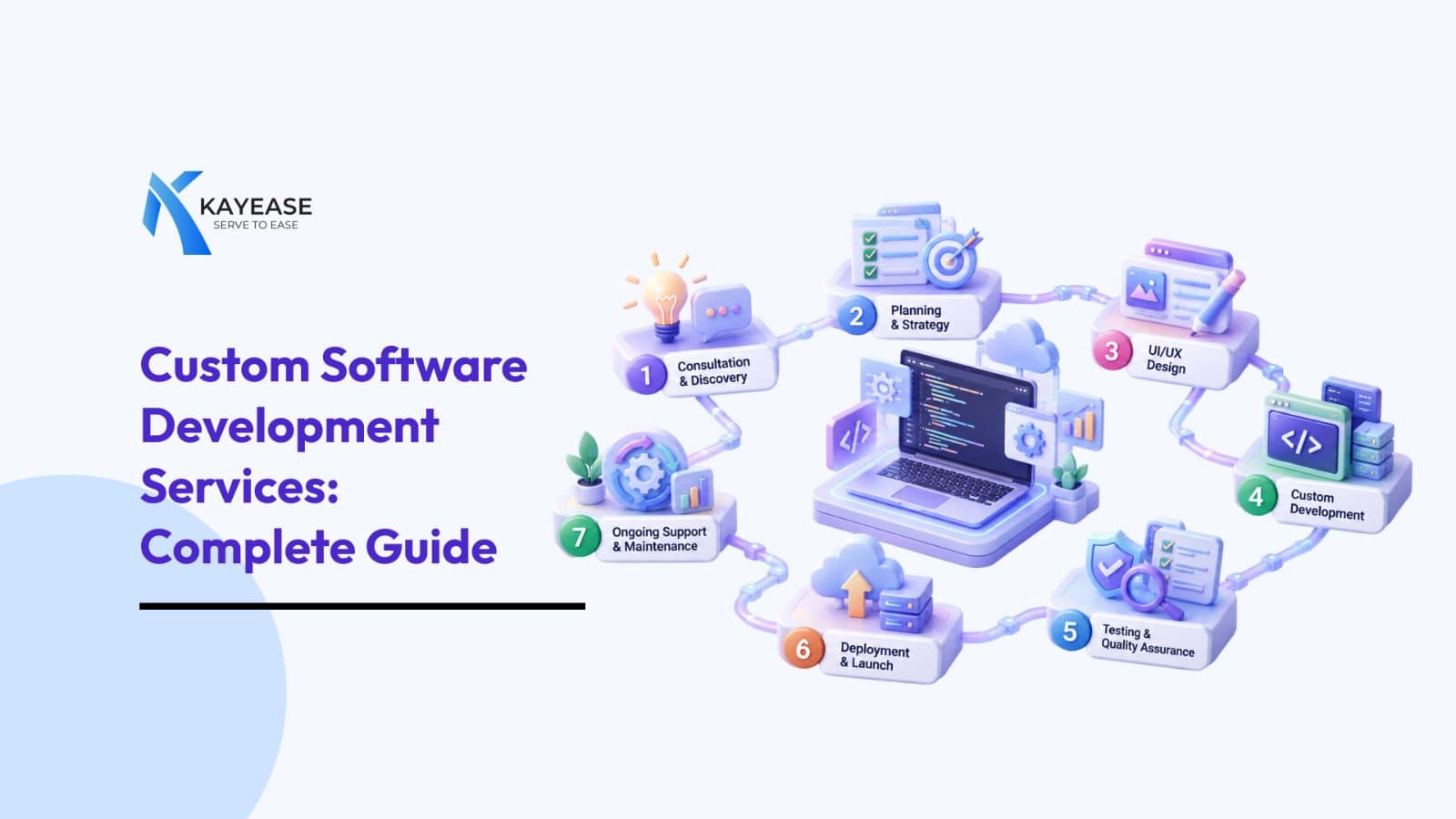
Custom Software Development Process
Building custom software involves several stages.
Step 1: Requirement Analysis
The first step is understanding the business.
Developers and business stakeholders identify:
- Business objectives
- Current challenges
- Target users
- Existing workflows
- Required features
- Technical requirements
- Budget
- Expected timeline
A clear requirement document helps reduce misunderstandings later.
Step 2: UI/UX Design
The next stage focuses on how users will interact with the software.
Designers create:
- User flows
- Wireframes
- Interface designs
- Dashboards
- Mobile layouts
- Prototypes
For Indian users, factors such as mobile-first usage, simple navigation, and regional accessibility may also be important.
Step 3: Development
Developers then build the actual software.
Depending on the project, this may include:
- Frontend development
- Backend development
- Database development
- API development
- Third-party integrations
- Authentication
- Security features
Step 4: Testing
Before launch, the software needs to be tested thoroughly.
Testing can identify:
- Functional bugs
- Security vulnerabilities
- Performance problems
- Compatibility issues
- UI problems
- Integration failures
Quality Assurance (QA) is an essential part of the development process.
Step 5: Deployment
Once the software passes testing, it can be deployed to a production environment.
Cloud platforms such as AWS, Microsoft Azure, or Google Cloud may be used depending on the project's requirements.
Step 6: Maintenance and Support
Software development doesn't end after launch.
Ongoing maintenance may include:
- Bug fixes
- Security updates
- Performance optimization
- Feature enhancements
- Infrastructure monitoring
- Technical support
Regular updates help ensure the software continues to meet changing business requirements.
How Much Does Custom Software Development Cost in India?
There is no fixed price for custom software development.
The cost depends on factors such as:
- Number of features
- Software complexity
- Number of users
- Platforms required
- UI/UX requirements
- Third-party integrations
- Security requirements
- Development timeline
- Maintenance requirements
A simple internal business application can cost significantly less than a complex fintech platform or enterprise ERP.
Therefore, businesses should evaluate total business value and ROI, rather than selecting a development partner purely based on the lowest quote.
Custom Software vs Ready-Made Software
Custom Software Ready-Made Software
Built for specific requirements
Built for a broad market
Highly configurable
Limited customization
Can scale with the business
Depends on provider
Can integrate with existing systems
Integrations may be limited
Higher initial development effort
Usually faster to start
Greater control over features
Features determined by vendor
The right choice depends on the organization's requirements, budget, and long-term technology strategy.
Benefits of Working With an Indian Software Development Company
For Indian businesses, working with a development company in India can provide several practical advantages.
Local Business Understanding
An Indian development team may already understand local business workflows, payment systems, customer behaviour, and operational requirements.
Cost Efficiency
India has a large technology talent pool, allowing businesses to access developers, designers, QA professionals, and project managers at competitive costs.
Easier Communication
Working within similar time zones can make meetings, development discussions, and support easier.
Long-Term Support
A reliable development partner can continue supporting the software after launch instead of treating development as a one-time project.
How to Choose the Right Custom Software Development Company
Choosing the right technology partner is as important as choosing the technology itself.
Look for a company that offers:
1. Relevant Experience
Review its previous projects and determine whether it has experience in your industry or with similar technical challenges.
2. Transparent Development Process
The company should clearly explain how it handles requirements, development, testing, deployment, and maintenance.
3. Strong Technical Team
Look for expertise across areas such as:
- Frontend development
- Backend development
- Mobile development
- Cloud computing
- Databases
- APIs
- Cybersecurity
- QA testing
4. Post-Launch Support
Ask what happens after the software goes live.
A strong technology partner should provide maintenance, updates, troubleshooting, and scalability support.
5. Security Practices
Security should be considered from the beginning, particularly for software handling financial, customer, employee, or educational data.
Is Custom Software Worth It for Your Business?
Custom software can be a strong investment when existing solutions cannot effectively support your business processes.
It may be particularly useful when:
- Your business has complex workflows.
- Employees rely heavily on spreadsheets or manual processes.
- You use several disconnected applications.
- Your existing software lacks important features.
- You need specialized integrations.
- Your business is growing rapidly.
- You want to build your own SaaS product.
- Data visibility and automation are becoming important.
However, not every business needs custom software. If an affordable off-the-shelf product already solves your requirements effectively, building from scratch may not be necessary.
The goal should not simply be to build software. The goal should be to solve a business problem through technology.
Final Thoughts
Custom software development is becoming an important part of digital transformation for Indian businesses. From CRM and ERP platforms to fintech applications, mobile apps, SaaS products, and industry-specific business systems, customized technology can help organizations automate processes, improve visibility, and scale more efficiently.
The right solution starts with understanding the business not with choosing a programming language.
For businesses considering custom software, the most important questions are:
What problem are we solving? Who will use the software? What should it automate? And how will it create measurable business value?
Once these questions are clear, the right technology strategy becomes much easier to build.
Never miss a post
Subscribe to our RSS feed and every new article lands in your reader automatically — no email, no algorithm.
Works with Feedly, Inoreader, NetNewsWire and any other reader. View raw feed