AI Chatbots vs Human Support for Business Growth
Discover the key differences between AI chatbots and human customer support, including cost, efficiency, scalability, empathy, and problem-solving abilities. Learn which solution is best for your business and how a hybrid support strategy can improve customer experience and operational performance.
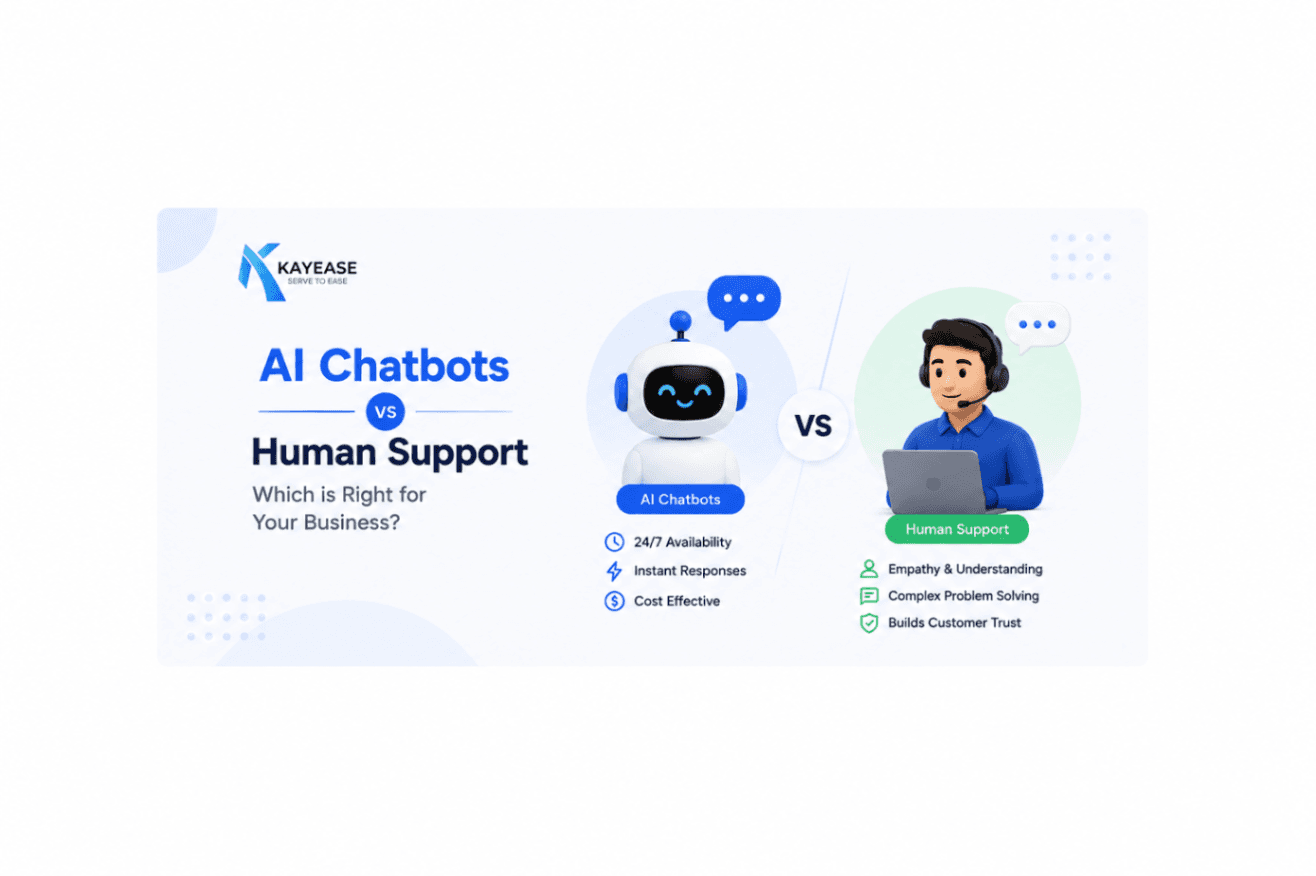
AI Chatbots vs Human Support: Which is Right for Your Business?
Abstract
Businesses today face growing pressure to deliver faster, smarter, and more personalized customer service. As digital transformation accelerates, companies are increasingly choosing between AI-powered chatbots and traditional human customer support systems. While AI chatbots provide instant responses, cost efficiency, and 24/7 availability, human support offers emotional intelligence, empathy, and complex problem-solving abilities. This article explores the advantages, limitations, and ideal use cases of both support methods to help businesses determine the right balance for their customer service strategy.
Introduction
Customer support has evolved dramatically over the last decade. Modern consumers expect immediate assistance, seamless communication, and personalized experiences across websites, mobile apps, and social media platforms. To meet these expectations, businesses are turning toward artificial intelligence (AI) chatbots as an alternative or supplement to human support teams.
AI chatbots are capable of answering common questions, automating repetitive tasks, and handling thousands of conversations simultaneously. However, despite technological advancements, many customers still value the empathy, understanding, and human connection that live agents provide.
The debate between AI chatbots and human support is not about which one is universally better. Instead, it focuses on identifying the right solution based on a company’s goals, customer expectations, industry, and budget. Understanding the strengths and weaknesses of both options is essential for building an efficient and customer-friendly support system.
What Are AI Chatbots?
AI chatbots are software applications powered by artificial intelligence, machine learning, and natural language processing (NLP). These systems interact with users through text or voice-based conversations and can automate customer support tasks.
Common uses of AI chatbots include:
- Answering frequently asked questions
- Order tracking and updates
- Appointment scheduling
- Lead generation
- Technical troubleshooting
- Customer onboarding
Popular chatbot platforms can now simulate human-like conversations and continuously improve based on user interactions.
Advantages of AI Chatbots
1. 24/7 Availability
Unlike human agents, chatbots can operate continuously without breaks. This allows businesses to provide instant support at any time of day, improving customer satisfaction.
2. Cost Efficiency
Hiring and training customer support representatives can be expensive. AI chatbots reduce operational costs by automating repetitive tasks and minimizing the need for large support teams.
3. Faster Response Times
Customers prefer quick answers. Chatbots can respond instantly, reducing wait times and improving efficiency.
4. Scalability
AI systems can manage thousands of customer interactions simultaneously, making them ideal for businesses experiencing high support volumes.
5. Consistent Responses
Chatbots deliver standardized information, reducing human errors and ensuring consistency in communication.
Limitations of AI Chatbots
1. Lack of Emotional Intelligence
AI systems cannot fully understand emotions, frustration, or complex human behavior. This can lead to unsatisfactory customer experiences in sensitive situations.
2. Difficulty Handling Complex Issues
Chatbots work best with structured and repetitive tasks. Complex customer problems often require human judgment and creativity.
3. Limited Personalization
Although AI is improving, many chatbots still struggle to provide deeply personalized support experiences.
4. Customer Frustration
Poorly designed bots can frustrate users if conversations become repetitive or fail to resolve issues effectively.
Advantages of Human Support
1. Empathy and Emotional Connection
Human agents can understand customer emotions and provide compassionate support, especially during difficult situations.
2. Advanced Problem-Solving
Humans can think critically, adapt to unique scenarios, and resolve complicated customer concerns more effectively.
3. Relationship Building
Personal interactions help businesses build trust and long-term customer loyalty.
4. Better Communication Flexibility
Human representatives can understand context, sarcasm, tone, and nuanced conversations that AI may misinterpret.
Limitations of Human Support
1. Higher Operational Costs
Salaries, training, infrastructure, and employee management significantly increase customer support expenses.
2. Limited Availability
Human agents require working hours, breaks, and shifts, which may limit round-the-clock support.
3. Slower Response Times
High ticket volumes can lead to long waiting times and customer dissatisfaction.
4. Inconsistent Service Quality
Different support agents may provide varying levels of service quality and information accuracy.
AI Chatbots vs Human Support: Key Comparison
Availability
- AI Chatbots: Available 24/7
- Human Support: Limited working hours
Response Time
- AI Chatbots: Instant responses
- Human Support: Usually slower depending on workload
Cost
- AI Chatbots: Lower operational costs
- Human Support: Higher staffing and training costs
Empathy
- AI Chatbots: Limited emotional understanding
- Human Support: High emotional intelligence and empathy
Complex Problem Solving
- AI Chatbots: Moderate capability
- Human Support: Excellent at handling complex issues
Scalability
- AI Chatbots: Can handle thousands of users simultaneously
- Human Support: Limited by team size
Personalization
- AI Chatbots: Moderate personalization
- Human Support: Strong personalized interaction
Consistency
- AI Chatbots: Highly consistent responses
- Human Support: May vary between agents.
So… Who Actually Wins? AI or Humans?
Neither.
Because the real winner is not AI or human support.
It is how you combine them.
The Hybrid Model: Where Most Businesses Are Heading
The most successful companies are now using a hybrid support system:
- AI handles first response and simple queries
- AI filters intent and urgency
- Humans step in when emotion or complexity increases
This creates something powerful:
Speed of machines + empathy of humans
And customers don’t feel the transition they just feel helped.
Which Is Right for Your Business?
The best choice depends on your business model, customer expectations, and operational goals.
Choose AI Chatbots If:
- You receive a high volume of repetitive inquiries
- You need 24/7 support
- You want to reduce customer service costs
- Your business requires fast response times
- You operate in e-commerce or SaaS industries
Choose Human Support If:
- Your business handles sensitive or emotional customer interactions
- You require personalized consultations
- Your products or services are highly complex
- Relationship-building is essential to your brand
The Hybrid Approach
For most businesses, combining AI chatbots with human support creates the best customer experience. Chatbots can handle routine tasks while human agents focus on complex or emotionally sensitive issues. This hybrid strategy improves efficiency without sacrificing customer satisfaction.
When Should You Use AI Chatbots?
AI is ideal when:
- You receive high-volume repetitive queries
- You need 24/7 availability
- You want to reduce support costs
- You want fast first-response time
- You need scalable support without hiring large teams
When Should You Use Human Support?
Human agents are essential when:
- Issues are emotionally sensitive
- Customers are frustrated or confused
- Decisions require judgment or exceptions
- High-value customers need attention
- Complex multi-step troubleshooting is required
The Real Secret: It’s Not Either/Or
The biggest misconception in customer support is thinking you must choose one.
In reality, the most successful systems are designed around one principle:
“Let machines handle the workload. Let humans handle the moments that matter.”
The Future of Customer Support
Customer support is moving toward predictive assistance.
Instead of waiting for customers to ask:
- Issues will be detected before complaints
- Refunds will be processed before escalation
- Delivery issues will be communicated proactively
- Support will become invisible, not reactive
This is where AI + human collaboration becomes essential.
Final Conclusion: What Should Your Business Do?
If your goal is:
- Speed → AI wins
- Empathy → Humans win
- Scalability + Trust → Hybrid wins
And in 2026, the businesses that win are not the ones choosing between AI and humans…
They are the ones designing systems where customers never feel the difference between them.
Because customers don’t care who answers.
They care whether their problem is solved fast, clearly, and respectfully.
Conclusion
AI chatbots and human support each offer unique strengths and limitations. Chatbots provide speed, automation, scalability, and cost savings, making them highly effective for routine customer service operations. Human support, on the other hand, delivers empathy, creativity, and advanced problem-solving that AI still cannot fully replicate.
Rather than viewing AI and human support as competing solutions, businesses should consider how both can work together. A balanced customer support strategy that combines automation with human interaction can maximize efficiency, improve customer experiences, and strengthen long-term business growth.
As AI technology continues to evolve, the future of customer support will likely depend on collaboration between intelligent automation and skilled human professionals.
Disclosure Statement
This article is intended for informational and educational purposes only. The opinions expressed are based on general industry research, technological trends, and customer service practices. Readers should evaluate their own business needs, operational requirements, and customer expectations before implementing AI or human support solutions.
Additional Information
Recommended Industries for AI Chatbots
- E-commerce
- Banking
- Travel and hospitality
- Telecommunications
- Healthcare scheduling
- SaaS businesses
Recommended Industries for Human Support
- Legal services
- Mental health services
- Luxury brands
- Financial consulting
- High-end customer relationship management
Future Trends
- AI-powered voice assistants
- Emotion-detection technology
- Personalized AI interactions
- Hybrid customer service ecosystems
- Advanced conversational AI models
References
- IBM – Artificial Intelligence and Chatbot
- Gartner Research on Customer Service Automation
- Microsoft Global State of Customer Service Report
- Harvard Business Review – The Future of AI in Customer Experience
- Forbes Technology Council Insights on AI Customer Support
- McKinsey & Company – AI Adoption in Business Operations
- Salesforce Customer Service Trends Report
Never miss a post
Subscribe to our RSS feed and every new article lands in your reader automatically — no email, no algorithm.
Works with Feedly, Inoreader, NetNewsWire and any other reader. View raw feed